
Vitamin A and Beta-Carotene in Companion Rabbits
Vitamin A is essential for healthy eyes and overall health, and most adult rabbits get enough from a high-quality hay-based diet. Fresh, green hay provides the safest natural source, while unnecessary vitamin A supplements can be harmful over time.
Abstract
Vitamin A nutrition in rabbits is best served by standardized use of natural carotenoids in quality hay. Curing, processing, and storage all lead to hay carotenoid losses. However, the dietary need of rabbits is still readily met by a quality hay-based diet despite these losses, making the addition of synthetic active vitamin A (retinol and retinol esters) nutritional nonsense for most companion rabbits.
1. Adult maintenance: what adult companion rabbits need
For a welfare-centered companion-rabbit diet, the best current numerical target is FEDIAF’s recommendation of 10,000 to 12,000 IU vitamin A/kg total diet for adult maintenance. FEDIAF also lists 6,000 to 10,000 IU/kg as a growth minimum range. Lebas’s rabbit review reaches a closely aligned practical conclusion: rabbit diets are generally covered by about 10,000 IU vitamin A/kg diet or about 30 mg beta-carotene/kg diet, with higher formulation allowances needed because vitamin A activity is lost during processing and storage (FEDIAF, 2024; Lebas, 2000). Rabbits can convert the beta-carotene in hay into vitamin A in the lining of the small intestine. Rabbit intestinal tissue has been shown to enzymatically split beta-carotene into retinal, which can then be turned into other vitamin A forms the body can use (Lakshman et al., 1989). This conversion is not simply automatic and unlimited. In mammals, when vitamin A status is sufficient, retinoic acid signaling increases a gut regulatory factor called ISX, which reduces both carotene uptake and carotene cleavage; when vitamin A status is lower, that brake relaxes (Lobo et al., 2010). This feedback model comes from broader mammalian research rather than a rabbit-only gut-regulation study, but it helps explain why carotene-rich forage is safer than adding preformed retinol directly into the diet. Rabbit requirement tables and rabbit toxicity studies still need to be interpreted in their own terms: adequacy guidance is based on rabbit feeding work, while toxicity concerns center on chronic excess preformed vitamin A (retinol) rather than on hay carotene. Therefore, the question is not how to maximize vitamin A, but how to provide enough without creating a chronic retinol burden that could trigger toxicity (Lebas, 2000; Lakshman et al., 1989; Folman et al., 1989). For most adult house rabbits, the practical diet is simple. Unlimited quality grass hay remains the foundation and a measured amount of a plain, high-fiber pellet to help close nutrient gaps.
2. Vitamin A is important for Ocular health
Vitamin A deficiency can damage the rabbit’s eye long before any other signs of chronic deficiency are visible. Vitamin A supports conjunctival goblet cells, mucin production, the smooth nonkeratinized ocular surface, and normal corneal epithelial differentiation. That is why vitamin A deficiency shows up in rabbit eye models as an ocular-surface disease: the surface becomes dry, unstable, and structurally abnormal, and only later becomes abnormally keratinized (Van Horn et al., 1980; Hatchell & Sommer, 1984). In Van Horn and colleagues’ classic rabbit model, xerophthalmia developed after 4 to 6 months on a vitamin A deficient depletion-diet. The earliest visible change was a lusterless gray appearance in the central corneal epithelium at about 16 to 18 weeks. Within another 7 to 10 days, small punctate epithelial erosions appeared. With further deficiency, the cornea took on a dry, glazed appearance and then developed thick keratinized plaques 1 to 2 weeks later. Electron microscopy showed early swelling of superficial epithelial cells and shortened microvilli before the surface failure was clinically obvious (Van Horn et al., 1980). Hatchell and Sommer added an especially useful clinical point: conjunctival impression cytology detected early change before the cornea looked dramatically diseased. They identified goblet-cell loss and enlarged epithelial cells that were measurable 4 to 6 weeks before obvious keratinization of the surface. Clearly, vitamin A deficiency can cause disruption of cell function long before dramatic blindness or late corneal damage is easily visible. Vitamin A is needed so that the ocular surface can maintain normal mucin-rich, nonkeratinized function to stay comfortable and healthy (Hatchell & Sommer, 1984). Rabbit lacrimal-gland studies suggest the gland itself may be less severely altered than the corneal and conjunctival surface in this species, although vitamin A deficiency can still reduce some aspects of tear and gland function. For companion-rabbit care, the safest interpretation is that vitamin A nutrition helps protect the whole ocular surface, but the cornea and conjunctiva are the most immediately relevant tissues when intake has been chronically poor (Ubels & Harkema, 1994; Rismondo et al., 1989).
3. Timothy hay as the main provitamin A source in adult companion rabbits
Most adult companion rabbits eat timothy and other grass hays. Published forage tables show that grass hay can provide meaningful carotenoid intake, but the range is wide and quality-dependent. Good green grass hay, including timothy hay, has been published at about 20 to 31 mg carotene/kg, while average bleached grass hay has been published at about 9 to 18 mg/kg. Alfalfa usually has higher levels of carotene, but that comparison is useful mainly because it shows why grass hay has a smaller safety margin for later losses (McDowell, 2000).
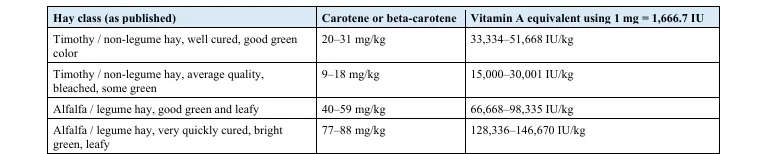
Table 1. Hay carotene ranges summarized by McDowell. McDowell’s forage table reports carotene ranges; the IU values above are shown as chemical vitamin A equivalents for comparison only (McDowell, 2000).
A hay-heavy adult diet can therefore contribute a lot of provitamin A activity even before pellets are counted. If 85% of the total diet is good green timothy hay, the hay fraction alone contributes about 17 to 26.35 mg carotene/kg total diet, which equals roughly 28,334 to 43,918 IU/kg vitamin A equivalent on the same basis. If the hay is bleached timothy at 9 to 18 mg/kg, the hay fraction contributes only about 7.65 to 15.3 mg/kg total diet, or about 12,750 to 25,501 IU/kg equivalent. Those wide ranges are one reason color, curing, and storage matter so much in practice.
Ballet and colleagues also help explain why timothy quality changes so fast with maturity and leaf loss. At early flowering, timothy leaves contained 387 mg/kg DM carotene, which equals about 645,013 IU/kg DM, while timothy stems contained only 95 mg/kg DM, or about 158,337 IU/kg DM before weather and storage begin to erode it (Ballet et al., 2000).
4. Curing losses: what happens before hay ever reaches the pellet mill
The first big carotene loss is the sharp drop from fresh forage to finished hay. Direct quantified haymaking experiments are easier to find for alfalfa/lucerne than for timothy, but they still show the right pattern for companion-rabbit nutrition: prolonged sun exposure, moisture, and rain damage can strip away large fractions of the original provitamin A value before the hay is baled (Ballet et al., 2000; Park et al., 1983; Vail et al., 1936).
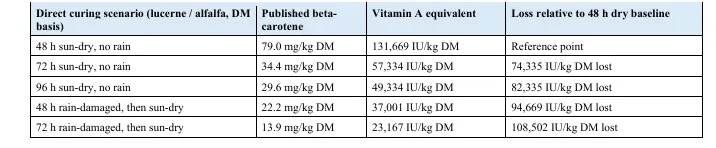

Table 2. Park et al. values as summarized in the forage review by Ballet et al. The numbers are direct alfalfa/lucerne data, shown here because comparable haymaking loss data are scarce for timothy. They still illustrate the size of the losses that prolonged sun exposure and rain can produce (Park et al., 1983; Ballet et al., 2000).
The older Colorado alfalfa bulletin points the same way. In hay exposed to a sun lamp meant to mimic ultraviolet light, losses ran about 20 to 50% compared with protected checks. Roller-crushing and faster drying improved retention enough that the crushed samples ended up 45% and 87% higher in vitamin A than their slower-dried checks. For a green timothy hay starting at 20 to 31 mg/kg carotene, a 20 to 50% curing loss would remove about 6,667 to 25,834 IU/kg equivalent, leaving roughly 16,667 to 41,334 IU/kg. That is why internal green color is a useful buying clue even though it is not an accurate lab assay (Vail et al., 1936; McDowell, 2000).
5. Manufacturing losses in hay-based pellets: pelleting with steam, pelleting without steam, and extrusion
By the time hay is cured, stored, ground, and processed, the remaining carotene levels will be much smaller than the fresh un-cut hay on the farm. The effect that hay-processing has on carotenoid content is clearly outlined in the scientific literature for alfalfa. This information is useful for the impacts those same processing methods have on the carotenoid content of grass hay because it identifies the main stressors: added moisture, high temperature, friction, oxygen exposure, and storage time (Adapa et al., 2004; McDowell, 2000).
In pilot alfalfa pelleting, Adapa and colleagues found that steam conditioning raised moisture by about 2.0 to 3.5% to a total moisture content of about 10 to 11%. It also raised the temperature to about 76 degrees C before the pellet die, and pellet-mill friction raised the material further to about 95 to 100 degrees C. Under these combined conditions of added steam, heat, and time led to a loss of about 30% of the carotene (Adapa et al., 2004).
Pelleting can be done under cooler temperatures and lower moisture by not using added steam. Frictional heating losses can also be reduced by adjusting the die compression ratio and speed of pelleting (reducing dwell time). Time spent at higher temperatures can also be significantly reduced by delivering room-temperature mash (ground and mixed formula ready for pelleting) to the pellet mill (dwell time is measured in seconds) and then immediately cooling the pellets in a cooling tower (time measured in minutes to achieve room temperature). At Sherwood Pet Health we follow these procedures and have been able to reduce carotene losses to about 4%.
Extrusion deserves even more caution because it occurs under conditions considerably harsher than ordinary pelleting because of the high pressure, higher moisture levels, and much higher temperatures that are much longer in duration. There is no published data comparing extrusion carotene loss specifically in grass hay or alfalfa hay. However, the beta-carotene extrusion model by Guzman-Tello and Cheftel gives a useful upper-temperature stress test using beta-carotene in a wheat-flour mix. Extrusion barrel temperatures can range from 125 to 200 degrees C and with moisture levels between 14% to 24%. These conditions destroyed about 38 to 73% of the initial all-trans beta-carotene (Guzman-Tello & Cheftel, 1990).
For guardians, the practical point is straightforward. A pellet can be 'made from hay' and still end up with much less carotene than the hay started with. The concern is whether the pellet still contains ample enough carotene to provide for the rabbits dietary need.
6. Storage losses: light, oxygen, temperature, and package design
Storage can remove as much or more carotene than manufacturing. Once hay is chopped or ground, surface area rises, oxygen exposure becomes more important, and light penetration increases and becomes more damaging. The research on hay points in the direction that darker, cooler, less oxygen-permeable storage preserves more carotene. A light-and-oxygen barrier, such as laminated packaging with a mylar foil barrier, can protect carotene better than cold temperature storage alone. (Vail et al., 1936; Kansas State Agricultural Experiment Station, 1953; Layug et al., 1995).
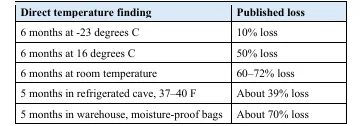
Table 4A. Temperature-driven carotene loss, using storage percentages summarized in the Kansas State dehydrated-alfalfa bulletin. (Kansas State Agricultural Experiment Station, 1953).
Clearly the storage temperature does impact carotene loss. Cooler temperatures preserve carotene. However, despite the storage temperature, the carotene losses are still large when compared to protection that a foil-laminate pouch provides (see below).
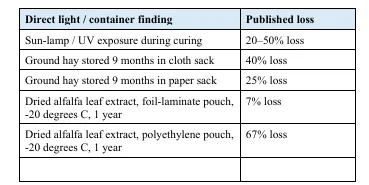
Table 4b. Direct alfalfa hay and meal storage findings. The underlying percentages are directly published (Vail et al., 1936).
The same bulletin also describes what happens when oxygen protection is broken. In one high-moisture, tightly sealed storage system, about 10% of carotene was lost after 5 months, but total loss rose to about 42% after the container was opened and the same material sat for one more month (Kansas State Agricultural Experiment Station, 1953).
For companion-rabbit pellets, that is a strong reminder that opening the bag is part of the shelf-life problem, not the end of it. Therefore, at any storage temperature, a fully opaque, high-barrier mylar-style pouch should preserve natural hay carotene better than a package without foil barrier that is oxygen and light permeable (Layug et al., 1995; Vail et al., 1936).
7. Deficiency and excess: the safe middle for companion rabbits
Vitamin A should be discussed as a range rather than as a single minimum number because rabbit studies document harm at both ends. Too little vitamin A can lead to eye-surface disease and, in more severe or prolonged deficiency, broader systemic and reproductive problems. Too much preformed vitamin A can also be harmful when exposure is chronic. (Lebas, 2000; DiGiacomo et al., 1992; St. Claire et al., 2004).
For companion-rabbit guardians, the important message is that there really is a lower and an upper bound, and both are good reasons to avoid improvising vitamin A supplementation. Most house rabbit nutritional planning should center on long-term gut health, dental wear, stable body condition, and healthy eye function. A quality forage-led diet supplies that need.
The safety distinction between preformed vitamin A and hay carotene also matters. The rabbit literature on chronic toxicity overwhelmingly concerns preformed vitamin A, usually retinyl esters added to the food or premix. Ordinary hay carotene is the safer everyday source because it is a provitamin A precursor whose conversion to vitamin A is regulated by the gut (Lebas, 2000; DiGiacomo et al., 1992).
8. Practical takeaways for guardians, rescues, and rabbit-savvy clinicians
• Keep adult companion rabbits on unlimited grass hay or fresh grass as the dietary base. Timothy and other grass hays are appropriate everyday hays, but greener, leafier hay carries a more useful carotene reserve than weathered brown hay.
• Use eye health as the most practical vitamin A lens. Vitamin A deficiency in rabbits is first and foremost an ocular surface problem: less mucin support, a drier rougher surface, and, if severe, corneal keratinization.
• Read hay color cautiously but not dismissively. Internal green color is not a laboratory assay, yet it is a meaningful clue because faster curing and better pigment preservation usually means more retained carotene.
• Remember that hay-based pellets are not the same as raw hay. Pelleting can remove roughly 30 to 40% of vitamin A activity, and high-temperature extrusion can destroy even more carotene under harsher conditions.
• Package design matters. Opaque, high-barrier packaging is more likely to preserve native hay carotene than clear or windowed packaging, especially once storage is warm or prolonged.
• Avoid routine vitamin A drops or supplements in healthy adult pets. The better strategy is a forage-led diet plus a pellet from a manufacturer that validates the finished food.
Conclusion Adult rabbits need reliable vitamin
A nutrition, but they do not usually need routine vitamin A supplementation when they are eating the kind of diet already recommended for rabbits: abundant grass hay, water, and a measured amount of a plain pellet to provide for nutritional gaps. The eye is the earliest warning sign because vitamin A deficiency disrupts the ocular surface long before a rabbit reaches textbook style signs of deficiency.
Timothy hay can make a meaningful contribution to vitamin A nutrition, but its carotenoid margin is narrower than alfalfa’s and easily eroded by slow curing, rain, pelleting, extrusion, light, oxygen, and warm storage. That is why bright green forage and careful handling matter. For adult companion rabbits, the humane target is steady adequacy without overshoot. In practice that means respecting both bounds: avoid true deficiency, and be equally cautious about long-term excess preformed vitamin A.
Conclusion
Adult rabbits need reliable vitamin A nutrition, but they do not usually need routine vitamin A supplementation when they are eating the kind of diet already recommended for rabbits: abundant grass hay, water, and a measured amount of a plain pellet to provide for nutritional gaps. The eye is the earliest warning sign because vitamin A deficiency disrupts the ocular surface long before a rabbit reaches textbook style signs of deficiency.
Timothy hay can make a meaningful contribution to vitamin A nutrition, but its carotenoid margin is narrower than alfalfa’s and easily eroded by slow curing, rain, pelleting, extrusion, light, oxygen, and warm storage. That is why bright green forage and careful handling matter. For adult companion rabbits, the humane target is steady adequacy without overshoot. In practice that means respecting both bounds: avoid true deficiency, and be equally cautious about long-term excess preformed vitamin A.
Works Cited
1. Adapa, P. K., L. G. Tabil, G. J. Schoenau, and S. Sokhansanj. 2004. “Pelleting Characteristics of Fractionated Sun Cured and Dehydrated Alfalfa Grinds.” Applied Engineering in Agriculture 20(6): 813–820. https://doi.org/10.13031/2013.17714.
2. Ballet, Nathalie, J. C. Robert, and P. E. V. Williams. 2000. “Vitamins in Forages.” In Forage Evaluation in Ruminant Nutrition, edited by D. I. Givens, E. Owen, R. F. E. Axford, and H. M. Omed, 399–431. Oxon, UK: CABI Publishing.
3.DiGiacomo, R. F., B. J. Deeb, and R. J. Anderson. 1992. “Hypervitaminosis A and Reproductive Disorders in Rabbits.” Laboratory Animal Science 42(3): 250–254. FEDIAF. 2024.
4. Nutritional Guidelines for Feeding Pet Rabbits. Brussels: European Pet Food Industry Federation.
5. Folman, Y., R. M. Russell, G. W. Tang, and G. Wolf. 1989. “Rabbits Fed on Beta-Carotene Have Higher Serum Levels of All-Trans Retinoic Acid Than Those Receiving No Beta-Carotene.” British Journal of Nutrition 62(1): 195–201.
6. Guzman-Tello, R., and J. C. Cheftel. 1990. “Colour Loss During Extrusion Cooking of Beta-Carotene-Wheat Flour Mixes as an Indicator of the Intensity of Thermal and Oxidative Processing.” International Journal of Food Science and Technology 25(4): 420–434.
7. Hatchell, Diane L., and Alfred Sommer. 1984. “Detection of Ocular Surface Abnormalities in Experimental Vitamin A Deficiency.” Archives of Ophthalmology 102(9): 1389–1393. https://doi.org/10.1001/archopht.1984.01040031131040.
8. Kansas State Agricultural Experiment Station. 1953. Dehydrated Alfalfa. Manhattan, KS: Kansas State College of Agriculture and Applied Science, Bulletin 356. 9. Lakshman, M. R., I. Mychkovsky, and M. Attlesey. 1989. “Enzymatic Conversion of All-Trans-Beta-Carotene to Retinal by a Cytosolic Enzyme from Rabbit and Rat Intestinal Mucosa.” Proceedings of the National Academy of Sciences of the United States of America 86(23): 9124–9128.
10. Layug, Dolores V., Mitsuaki Ohshima, Henry T. Ostrowski-Meissner, and Hiro-omi Yokota. 1995. “Effect of Antioxidants and Storage Conditions on the Retention of Carotenoids in Alfalfa Leaf Extract.” Journal of the Japanese Society of Grassland Science 40(4): 410–419. https://doi.org/10.14941/grass.40.410.
11. Lebas, François. 2000. “Vitamins in Rabbit Nutrition: Literature Review and Recommendations.” World Rabbit Science 8(4): 185–192.
12. Lobo, Glenn P., Susanne Hessel, Anne Eichinger, Noa Noy, Alexander R. Moise, Adrian Wyss, Krzysztof Palczewski, and Johannes von Lintig. 2010. “ISX Is a Retinoic Acid-Sensitive Gatekeeper That Controls Intestinal Beta,Beta-Carotene Absorption and Vitamin A Production.” FASEB Journal 24(6): 1656–1666. https://doi.org/10.1096/fj.09-150995.
13. McDowell, Lee Russell. 2000. Vitamins in Animal and Human Nutrition. 2nd ed. Ames: Iowa State University Press.
14. Park, Y. W., M. J. Anderson, J. L. Walters, and A. W. Mahoney. 1983. “Effects of Processing Methods and Agronomic Variables on Carotene Contents in Forages and Predicting Carotene in Alfalfa Hay with Near-Infrared-Reflectance Spectroscopy.” Journal of Dairy Science 66: 235–245.
15. Payne, A. S., E. Donefer, and R. D. Baker. 1972. “Effects of Dietary Vitamin A on Growth and Reproduction in Rabbits.” Canadian Journal of Animal Science 52(1): 125–136.
16. Rismondo, V., T. B. Osgood, P. Leering, M. G. Hattenhauer, J. L. Ubels, and H. F. Edelhauser. 1989. “Electrolyte Composition of Lacrimal Gland Fluid and Tears of Normal and Vitamin A-Deficient Rabbits.” CLAO Journal 15(3): 222–229.
17. St. Claire, M. B., M. J. Kennett, and C. L. Besch-Williford. 2004. “Vitamin A Toxicity and Vitamin E Deficiency in a Rabbit Colony.” Contemporary Topics in Laboratory Animal Science 43(4): 26–30.
18. Ubels, J. L., and J. R. Harkema. 1994. “The Rabbit Lacrimal Gland in Vitamin A Deficiency.” Investigative Ophthalmology and Visual Science 35(3): 1249–1253. 19. Vail, C. E., J. W. Tobiska, and Earl Douglass. 1936. Further Studies on Vitamins in Alfalfa Hay. Colorado Agricultural Experiment Station Technical Bulletin 18. 20. Van Horn, D. L., W. H. Schutten, R. A. Hyndiuk, and P. Kurz. 1980. “Xerophthalmia in Vitamin A-Deficient Rabbits: Clinical and Ultrastructural Alterations in the Cornea.” Investigative Ophthalmology and Visual Science 19(9): 1067–1079.